


Tropical Storm Adds to Philippines’ Weather Toll with 25 Dead and 278,000 Evacuated This Week 

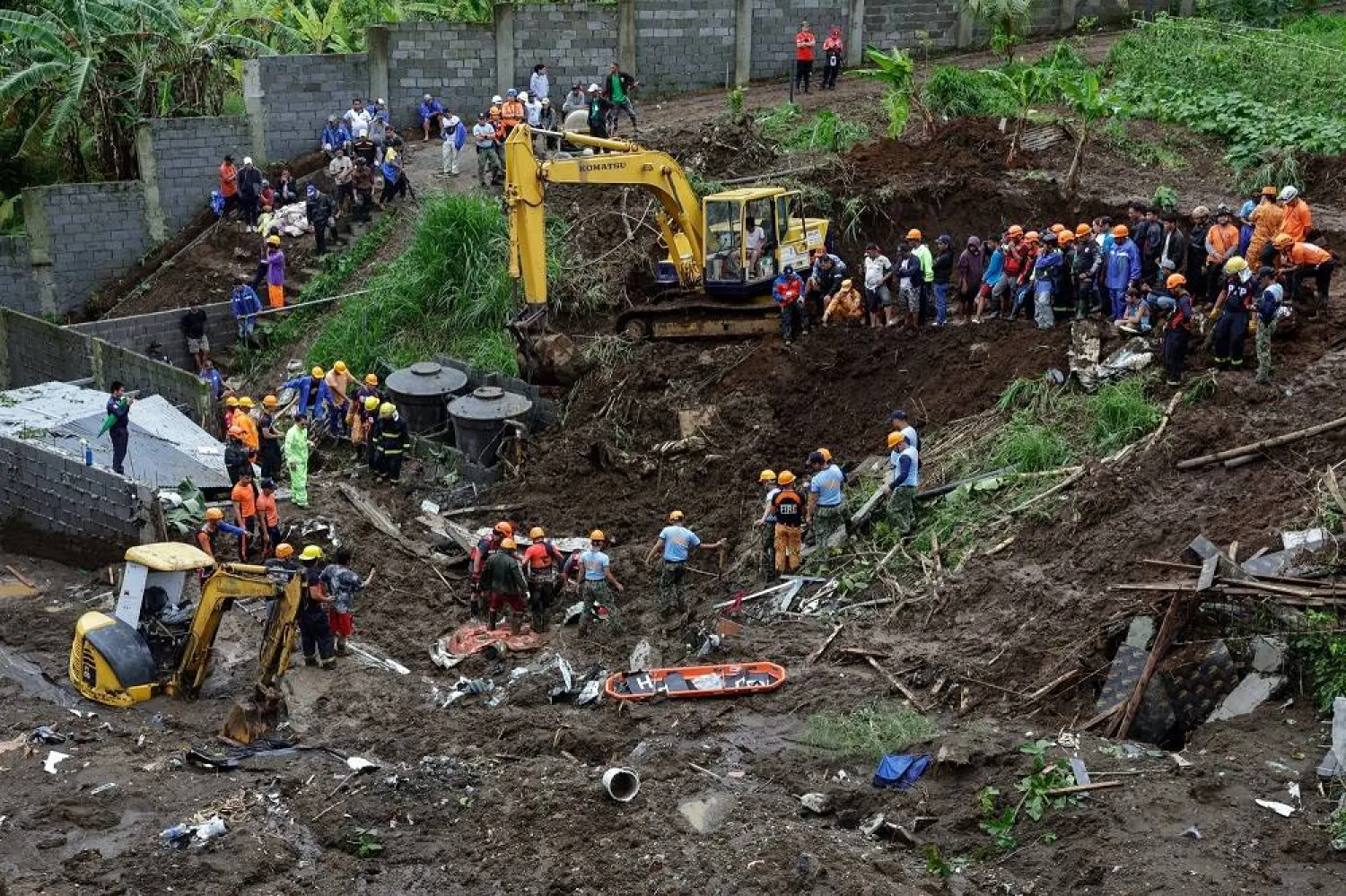
Emergency responders retrieve the body of a worker a day after a landslide hit a construction site following days of typhoon-driven rains, in Cavite province, south of Manila, Philippines, 25 July 2025. (EPA)
TT

Tropical Storm Adds to Philippines’ Weather Toll with 25 Dead and 278,000 Evacuated This Week 

Emergency responders retrieve the body of a worker a day after a landslide hit a construction site following days of typhoon-driven rains, in Cavite province, south of Manila, Philippines, 25 July 2025. (EPA)

A tropical storm was blowing across the Philippines' mountainous north Friday, worsening more than a week of bad weather that has caused at least 25 deaths and prompted evacuations in villages hit by flooding and landslides.

The storm was Typhoon Co-may when it blew Thursday night into the town of Agno in Pangasinan province with maximum sustained winds of 120 kilometers (74 miles) per hour and gusts of up to 165 kph (102 mph). It was weakening as it advanced northeastward and had sustained winds of 85 kph (53 mph) Friday afternoon.

Co-may was intensifying seasonal monsoon rains that had swamped a large swath of the country for more than a week.

Disaster-response officials have received reports of at least 25 deaths since last weekend, mostly due to flash floods, toppled trees, landslides and electrocution. Eight other people were reported missing, they said.

There were no immediate reports of deaths or injuries directly caused by Co-may, locally called Emong, the fifth weather disturbance to hit the Philippines since the rainy season started in last month. More than a dozen more tropical storms were expected to batter the Southeast Asian country the rest of the year, forecasters said.

The government shut down schools in metropolitan Manila for the third day Friday and suspended classes in 35 provinces in the main northern region of Luzon. More than 80 towns and cities, mostly in Luzon, have declared a state of calamity, a designation that speeds emergency funds and freezes the prices of commodities, including rice.

The days of stormy weather have forced 278,000 people to leave their homes for safety in emergency shelters or relatives’ homes. Nearly 3,000 houses have been damaged, the government’s disaster response agency said.

Travel by sea and air has been restricted in northern provinces being pounded or in the typhoon’s path.

Thousands of army forces, police, coast guard personnel. firefighters and civilian volunteers have been deployed to help rescue people in villages swamped in floodwaters or isolated due to roads blocked by landslides, fallen trees and boulders.

The United States said it will provide $250,000 in funding to the UN World Food Program to help the Philippine government's response. “We are tracking the devastation caused by the storms and floods and are deeply concerned for all those affected,” US Ambassador MaryKay Carlson said.

After returning from his White House meeting with US President Donald Trump, President Ferdinand Marcos Jr. visited emergency shelters Thursday in Rizal province to help distribute food packs to displaced residents.

He later convened an emergency meeting with disaster-response officials, where he underscored the need for the government and the people to adapt to and brace for climate change and the larger number of and more unpredictable natural calamities it’s setting off.

“Everything has changed,” Marcos said. “Let’s not say, ‘The storm may come, what will happen?’ because the storm will really come.”

The United States, Manila’s longtime treaty ally, has pledged to provide military aircraft to airlift food and other aid to remote island provinces and the countryside if the calamity worsens, the Philippines military said.

The Philippines, which lies between the Pacific Ocean and the South China Seas, is battered by about 20 typhoons and storms each year. It’s often hit by earthquakes and has about two dozen active volcanoes, making it one of the world’s most disaster-prone countries.



Report: Dual-Use Items Likely Onboard Seized Iranian Ship

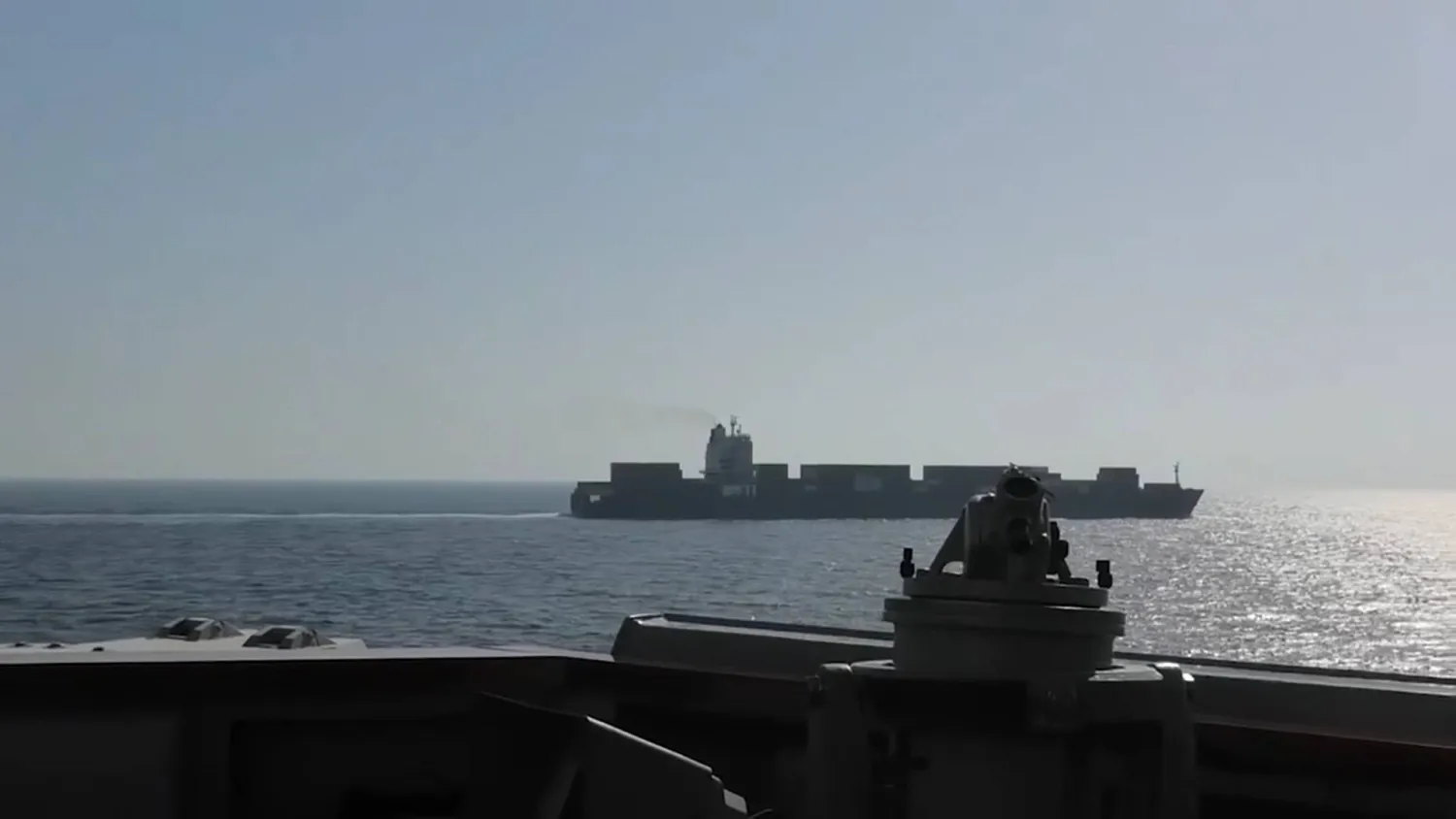
A view of Iranian-flagged cargo ship M/V Touska as the US Navy Arleigh Burke-class Aegis guided missile destroyer USS Spruance conducts its interception in a location given as the north Arabian Sea, in this screen capture from a video released April 19, 2026. (CENTCOM/Handout via Reuters)
TT

Report: Dual-Use Items Likely Onboard Seized Iranian Ship

A view of Iranian-flagged cargo ship M/V Touska as the US Navy Arleigh Burke-class Aegis guided missile destroyer USS Spruance conducts its interception in a location given as the north Arabian Sea, in this screen capture from a video released April 19, 2026. (CENTCOM/Handout via Reuters)

The Iranian-flagged container ship Touska, which was boarded and seized by US forces on Sunday, is likely to have what Washington deems dual-use items ‌that could be used by the military onboard, maritime security sources said on Monday, according to Reuters.

The small container ship, which is part of the Islamic Republic of Iran Shipping Lines (IRISL) group that has been hit with US sanctions, was boarded on Sunday off the coast of Iran's Chabahar port in the Gulf of Oman and last reported its position at 13:08 GMT, according to ship-tracking data on the Marine Traffic platform.

The US Central Command said Touska's crew failed to comply with repeated warnings over a six-hour period, and that the vessel was in violation of a US blockade.

The security sources, who declined to be identified, said their initial assessments were ⁠the vessel was likely to be carrying dual-use items after a voyage from Asia.

The vessel had previously transported items deemed as dual-use, one of the sources said.

The sources did not go into details on the items.

The US Central Command has listed metals, pipes and electronic components among other goods that could have a military, as well as an industrial use and could be captured.

The Iranian foreign ministry did not comment on the incident.

Iran's military said the ship had been travelling from China and accused the US of “armed piracy,” according to state media on Monday. They said they were ready to confront US forces over the “blatant aggression,” but were constrained by the presence of crew ‌members’ families ⁠on board.

Washington imposed sanctions on IRISL in late 2019, describing it as “the preferred shipping line for Iranian proliferators and procurement agents,” which included transporting items intended for Iran’s ballistic missile program.

The Touska's crew includes an Iranian captain and Iranian crew members, although it was not clear if the entire crew were Iranian nationals, one of the sources said.

IRISL ships are under the control of the Revolutionary Guards and their crew are typically made up mainly of Iranians and sometimes also use Pakistani seafarers, two other sources added.

The vessel was detected alongside at China’s Taicang port, ⁠which is north of Shanghai, on March 25 and arrived at China's southern Gaolan port on March 29-30, according to satellite analysis from data analytics specialists SynMax.

The vessel loaded containers onboard in Gaolan and then made a stop around the Port Klang anchorage in Malaysia on April 11-12 where it loaded further containers, according to SynMax analysis.

The vessel was laden with containers onboard ⁠when it reached the Gulf of Oman on Sunday.

China has expressed concern over the “forced interception” by the US of the Iranian-flagged cargo ship, a Chinese foreign ministry spokesperson said on Monday, urging relevant parties to abide by the ceasefire agreement in a responsible manner.

US President Donald Trump said in a post on the Truth Social platform on ⁠Sunday that the Touska was under US sanctions due to its “prior history of illegal activity,” adding that US forces were “seeing what’s on board.”

The US military widened its shipping blockade on Iran to include cargoes deemed contraband and any vessels suspected of trying to reach Iranian territory will be “subject to belligerent right to visit and search,” the US navy said in an advisory on Thursday.


Trump Says Recovering Iran Uranium ‘Will Be a Long and Difficult Process’

Airstrike craters are seen at the perimeter installation on Iran's Fordo Fuel Enrichment Plant (FFEP), Qom, Iran, June 24, 2025. (AFP)
TT

Trump Says Recovering Iran Uranium ‘Will Be a Long and Difficult Process’

Airstrike craters are seen at the perimeter installation on Iran's Fordo Fuel Enrichment Plant (FFEP), Qom, Iran, June 24, 2025. (AFP)

US President Donald Trump said late Monday the United States obtaining uranium from Iran would be "long" and "difficult" in the aftermath of last year's US strikes on Tehran's nuclear sites.

"Operation Midnight Hammer was a complete and total obliteration of the Nuclear Dust sites in Iran," Trump wrote on his Truth Social platform, adding: "Therefore, digging it out will be a long and difficult process."

The US leader regularly uses the term "nuclear dust" to refer to Iran's stock of enriched uranium, which the United States accuses Iran of hoarding in order to make an atomic bomb.

But he has also sometimes used it to refer to material left from US strikes on Iran's nuclear facilities in June last year.

The 79-year-old president maintains Iran's stockpile of enriched uranium would ultimately be transferred to US territory, despite Iran's foreign ministry denying any such plans.

The United States and Israel launched joint strikes on Iran on February 28 to remove what Israel described as "the existential threat" posed by the country's nuclear program.

Israeli officials say Tehran had stepped up efforts to acquire an atomic weapon since the end of the 12-day war in last June, which was launched by Israel and included US bombings of three nuclear facilities, including an enrichment plant.


US, Iran Warn Ready for War as Talks in Limbo

 Police officers stand guard on a road leading to the Serena Hotel, as Pakistan prepares to host the US and Iran for the second phase of peace talks in Islamabad, Pakistan, April 21, 2026. (Reuters)
Police officers stand guard on a road leading to the Serena Hotel, as Pakistan prepares to host the US and Iran for the second phase of peace talks in Islamabad, Pakistan, April 21, 2026. (Reuters)
TT

US, Iran Warn Ready for War as Talks in Limbo

 Police officers stand guard on a road leading to the Serena Hotel, as Pakistan prepares to host the US and Iran for the second phase of peace talks in Islamabad, Pakistan, April 21, 2026. (Reuters)
Police officers stand guard on a road leading to the Serena Hotel, as Pakistan prepares to host the US and Iran for the second phase of peace talks in Islamabad, Pakistan, April 21, 2026. (Reuters)

The United States and Iran each warned they were ready for war as the clock ticked down Tuesday on a ceasefire, with uncertainty on talks that President Donald Trump had announced would resume in Pakistan.

The White House said Vice President JD Vance was ready to fly back to the Pakistani capital Islamabad, which was preparing for a second round of talks on ending the war that has engulfed the Middle East and shaken global markets.

But Tehran's cleric-run government declined to confirm that it would participate and accused the United States of violating the truce through its blockade of Iranian ports and seizure of a ship.

"By imposing a blockade and violating the ceasefire, Trump wants to turn this negotiating table into a surrender table or justify renewed hostilities, as he sees fit," said Iran's powerful parliament speaker Mohammad Bagher Ghalibaf, who headed the delegations to talks two weeks ago in Pakistan.

"We do not accept negotiations under the shadow of threats, and in the last two weeks we have been preparing to show new cards on the battlefield," he wrote on X.

Iran's Revolutionary Guards warned of targeting any vessel attempting to pass through the Strait of Hormuz without permission.

Trump has similarly accused Tehran of violating the truce by harassing vessels in the key strait, the transit passage for about a fifth of the world's oil that Iran had all but shut in retaliation for the war launched February 28 by the United States and Israel.

The channel in peacetime sees around 120 daily transits, according to Lloyd's List, a shipping industry intelligence site.

On Tuesday, the site reported that more than 20 Iranian so-called "shadow vessels", had transited past the US blockade.

In one of a series of posts on his Truth Social platform, Trump insisted that the blockade was "absolutely destroying" Iran and said it will not end "until there is a 'DEAL'," in which the United States is pressing for Iranian concessions on its contested nuclear program.

- 'Agreed' to attend talks -

Trump told PBS News that Iran was "supposed to be there" at the talks in Pakistan.

"We agreed to be there," he said, warning that if the ceasefire expired "then lots of bombs start going off".

He separately told Bloomberg News it was "highly unlikely" he would extend the two-week truce.

Based on its start time, the truce theoretically expires overnight Tuesday, Tehran time, although in his comments to Bloomberg, Trump said the end was a day later, on Wednesday evening Washington time.

Oil prices fell on Tuesday while most stocks rose on lingering hopes for a deal to end the US-Iran war and reopen the Strait of Hormuz, even as Tehran said it had not decided whether to attend peace talks.

Despite some normalcy of life returning to Tehran during the ceasefire, city residents who spoke to Paris-based AFP journalists said the situation was far from rosy.

"Let's see what happens by Tuesday," one 30-year-old doctor said on condition of anonymity.

Saghar, 39, said there was little hope for Iranians squeezed by the government and the war's impact, adding that the "economy is horrible".

- New Israel-Lebanon talks -

A separate ceasefire agreed between Israel and Lebanon was announced on Friday and included Hezbollah, whose rocket fire in support of Iran drew Lebanon into the war.

Israel and Lebanon, which have no diplomatic relations, will hold a second round of talks on Thursday in Washington, a State Department official told AFP.

Sporadic violence continued and Israel's military warned civilians against returning to dozens of villages in southern Lebanon, claiming Hezbollah's activities were violating the truce.

The UN Security Council condemned on Monday the killing of a French peacekeeper in Lebanon, whose death France blamed on Hezbollah.

The Frenchman was killed and three others wounded when their unit was ambushed on Saturday as it headed to a UN Interim Force in Lebanon (UNIFIL) outpost cut off from the fighting between Hezbollah and Israel.

Hezbollah lawmaker Hassan Fadlallah told AFP that his group would work to break the "Yellow Line" that Israel has established in the south, even as he said it wanted "the ceasefire to continue".

Israeli attacks on Lebanon have killed at least 2,387 people since the start of the war, a Lebanese government body said in its latest toll.

Another major issue in the US-Iran negotiations has been Tehran's stockpile of enriched uranium, which Trump said on Friday it had agreed to hand over.

But Iran's foreign ministry has said the stockpile, thought to be buried from US bombing in last June's 12-day war with Israel, was "not going to be transferred anywhere".

Spokesman Esmaeil Baqaei said handing over uranium was "never raised as an option" in talks with US negotiators.